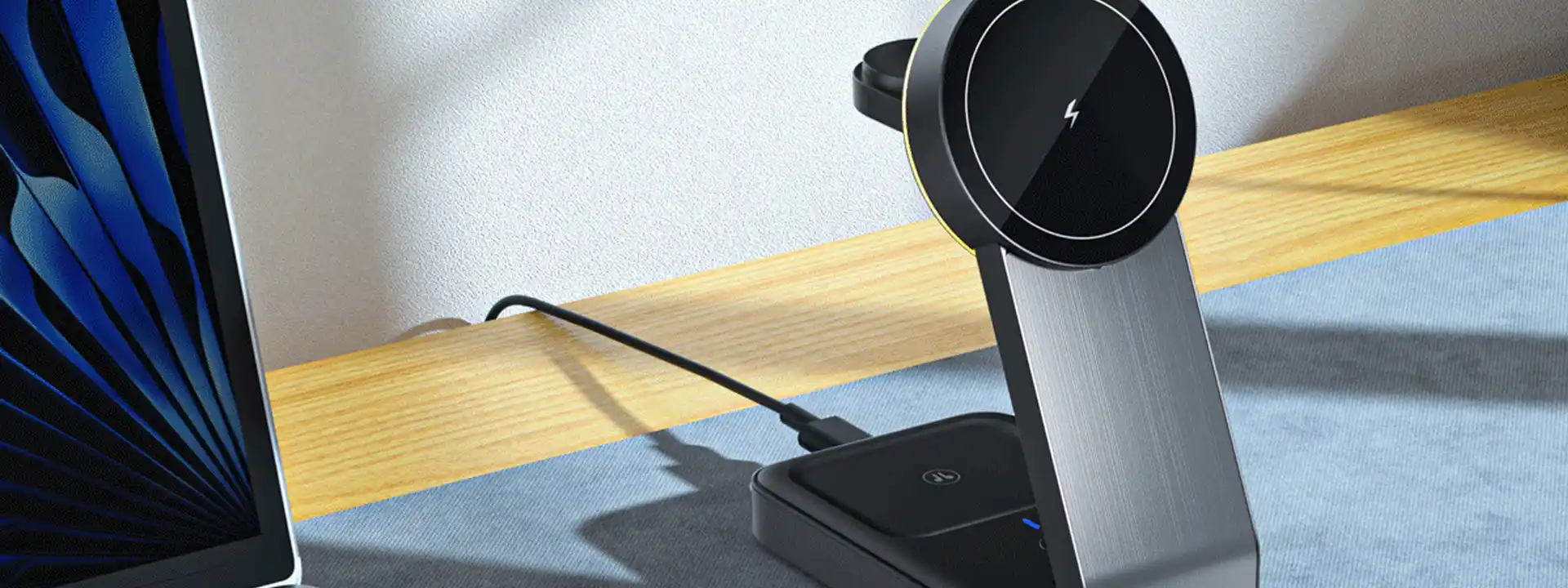
The Great Charging Debate
It's one of the most common questions I get from clients: should I get a wireless charging stand or a flat pad? The answer isn't straightforward because both have legitimate use cases where they excel. Let me break down everything you need to know to make the right choice for your situation.
After testing hundreds of both types across every possible scenario—desk work, bedside charging, travel, and office environments—I've developed a clear framework for when each design makes sense. I've also learned that most people actually need both in their lives, but I'll explain that later.
My Personal Journey with Both Designs
I started my wireless charging journey like most people: with a simple flat pad on my nightstand. It worked fine for overnight charging, but when I got more serious about desk work, I found myself constantly picking up my phone to check notifications. That frustration led me to try a stand, and the difference was immediate.
Now I keep a stand at my office desk and a pad on my nightstand. My wife, who primarily charges her phone at night, is perfectly happy with her flat pad and doesn't see the appeal of my desk stand. This is the perfect example of how the "right" choice depends entirely on your habits and needs.
Understanding the Designs
Wireless Charging Stands
Charging stands hold your phone at an angle—typically 30-45 degrees—so you can see notifications, use face unlock, or even watch videos while charging. They're designed for "active" use, where you interact with your phone while it's on the charger.
Wireless Charging Pads
Flat pads are the classic wireless charging design. You simply place your phone flat on the surface and let it charge. They're ideal for "passive" use, where you set your phone down and leave it until you need it again.
Charging Stands: Pros and Cons
Advantages:
- Visibility: See notifications at a glance without picking up your phone
- Face ID: Works seamlessly with face unlock since your phone is upright
- Video calls: Can join video calls while charging without holding your phone
- Navigation: Perfect for following GPS directions while charging in a mount
- Ergonomic: Reduces neck strain compared to looking down at a flat phone
Disadvantages:
- Larger footprint: Takes more desk space than a flat pad
- Phone size matters: Larger phones may feel unstable on some stands
- Charging orientation: Must place phone in correct orientation
- Travel unfriendly: Less compact for packing
Charging Pads: Pros and Cons
Advantages:
- Compact: Takes minimal desk or nightstand space
- Flexible placement: Phone can be placed in any orientation
- Multi-device: Often easier to charge multiple devices side by side
- Travel-friendly: Easy to pack and take anywhere
- Nightstand friendly: Won't catch on things or look obtrusive
- Affordable: Generally cheaper than comparable stands
Disadvantages:
- No visibility: Can't see notifications without picking up phone
- Face unlock issues: May need to enter passcode
- No video viewing: Can't watch content while charging
- Accidental removal: Easy to accidentally knock phone off
Best Use Cases
Choose a Stand If:
- Your desk is your workstation: You'll appreciate seeing notifications while you focus on computer work
- You take video calls: Join meetings while your phone charges
- You use GPS navigation: Perfect for in-car mounting or desk navigation
- You have a standing desk: Easy to glance at your phone while working
Choose a Pad If:
- Nightstand charging: Set it and forget it until morning
- Small spaces: Minimal footprint is critical
- Multiple users: Different people can place phones in any direction
- Travel frequently: Easy to pack in a bag
- Bedside charging: Won't disturb your sleep with bright screens
Hybrid Solutions
If you're still torn, there are hybrid options worth considering. Some chargers offer a flat pad with an adjacent stand, letting you choose based on your current needs. Others have adjustable angles that let you switch between flat and inclined positions.
These typically cost more than single-function chargers, but the flexibility can be valuable if your needs vary throughout the day.
The Final Verdict
In my experience, most people should actually have both: a stand at their desk for active use during work hours, and a pad on their nightstand for passive overnight charging. This combination covers all use cases without compromise.
If you can only choose one, consider your primary use case. If your phone serves as a work tool on your desk, the stand wins. If it's primarily a communication device you charge while sleeping or between activities, the pad makes more sense.
Making Your Decision
Don't overthink this. The difference between a stand and a pad isn't huge in terms of charging performance—both will reliably charge your phone. The choice is really about how you interact with your phone during the day.
Still unsure? Try this exercise: Think about where your phone is when you're not using it. If it's usually in your hand or on your desk within arm's reach, a stand makes more sense. If it usually goes on a surface and stays there until you need it, a pad is probably your best bet.
Explore Our Collection
We offer both stands and pads from verified manufacturers. Find the perfect charger for your specific setup and needs.
Browse All Chargers